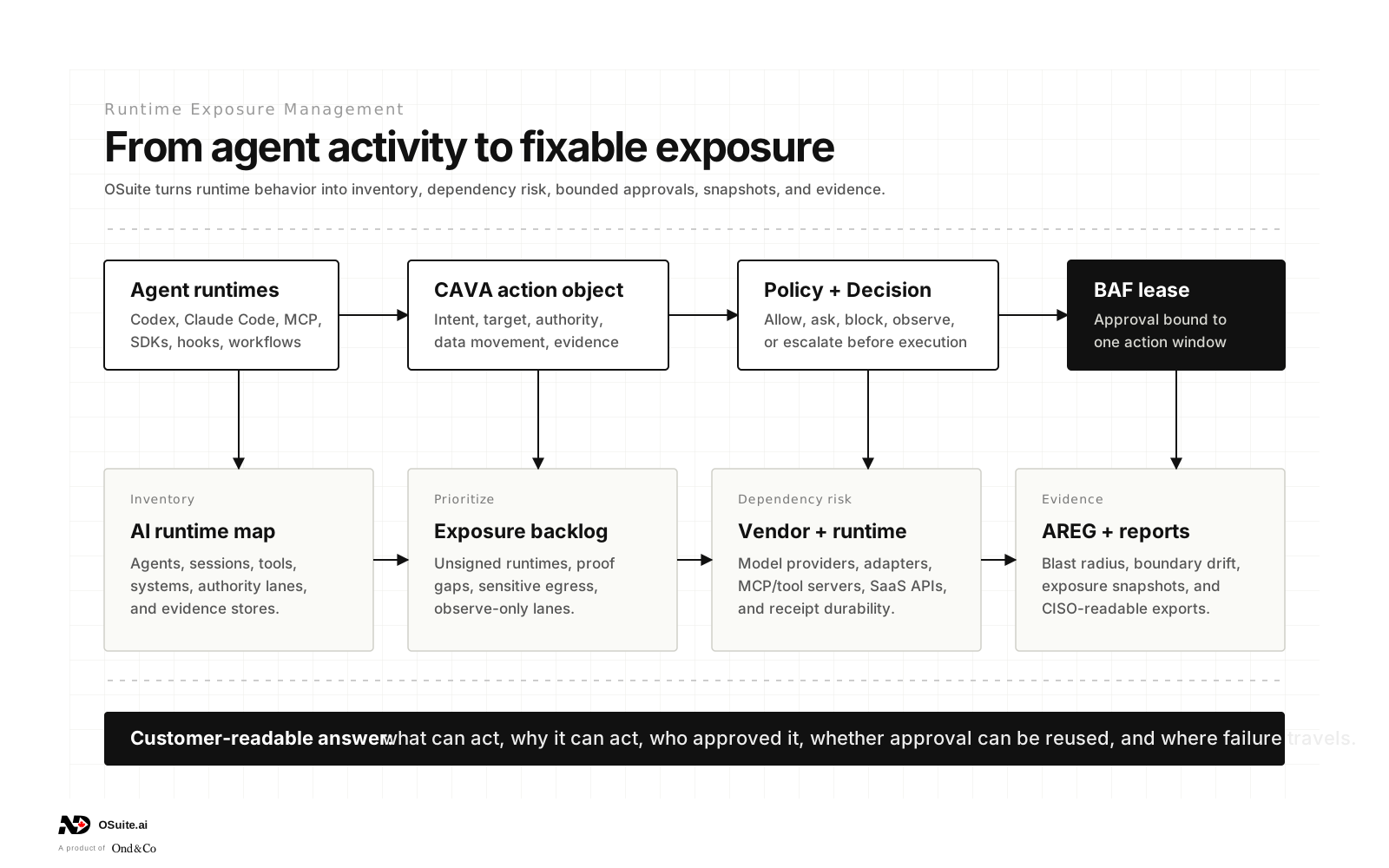
Runtime Exposure Management is where AI governance becomes operational.
AI governance should not stop at policy language or model posture. For agentic systems, the buyer needs to see what can act, what it can reach, where approval is bounded, and whether exposure is improving.
Runtime Exposure Management applies CTEM-style thinking to agent actions instead of only networks, identities, or cloud assets.
OSuite connects CAVA, policy profile, Decision Score, BAF, AREG, dependency risk, and exposure snapshots into one buyer-visible control path.
The useful question is not whether an AI system exists. It is what the agent can do, what it can reach, and what proof remains after it acts.
Enterprise AI security is slowly becoming more honest.
The first phase of the market asked whether employees were using AI. The second phase asked whether AI vendors were safe enough. The next phase will ask a harder and more useful question: what can the agent actually do inside the business?
That is a different problem from model safety, prompt hygiene, employee acceptable-use policy, or a dashboard of AI activity. It is a runtime exposure problem. A company can have a careful AI policy and still allow an agent to touch production systems with unclear authority. It can have a secure model provider and still create a dangerous local workflow. It can have logs and traces and still fail to prove whether a human approval applied to the action that actually executed.
OSuite's answer is Runtime Exposure Management. The phrase is deliberately practical. We are not trying to create another acronym for a new product silo. We are taking the security patterns buyers already understand from Continuous Threat Exposure Management, cloud posture, identity posture, and runtime protection, and applying them to the part of AI governance that matters most for agents: action.
OSuite Runtime Exposure Management
Why exposure is the right frame
Traditional security teams already know that inventory by itself is not enough. Knowing that a server exists does not tell you whether it is reachable from the internet, whether it has privileged credentials, whether it can reach a crown-jewel system, whether its controls are enforceable, or whether a compensating control actually reduces risk.
The same is true for AI agents.
An AI inventory that says "we use Codex," "we use Claude Code," "we use internal MCP servers," or "we use an agent workflow platform" is useful, but incomplete. The buyer question is not only whether these systems exist. The buyer question is what they can touch, what actions they can perform, what identity they use, what approval path applies, what runtime evidence is available, and what business surface is exposed if the action is wrong.
That is why the language of exposure is more useful than the language of generic governance. Governance can remain abstract. Exposure forces the system to answer what is reachable, what is allowed, what is bounded, and what can be proven.
CTEM for agent actions
Continuous Threat Exposure Management was not created for AI agents, but the operating model is valuable. Scope the environment, discover reachable assets and behaviors, prioritize the exposures that matter, validate whether the control works, and mobilize remediation.
For agentic systems, the loop changes shape:
CTEM step
Agent runtime translation
Scope
Which agent runtimes, MCP servers, hooks, SDKs, workflows, and tools are allowed to operate?
Discover
Which actions were attempted, which systems were touched, and which identity or runtime lane produced the action?
Prioritize
Which actions cross production, customer data, financial, external communication, source-code, or privileged-administration boundaries?
Validate
Does the policy profile route the action correctly, and does the approval bind to the final action rather than a wrapper description?
Mobilize
Who owns the fix, what evidence is missing, which runtime needs signature/proof coverage, and what should be reduced or blocked first?
This is where OSuite becomes more than a decision log. Runtime Exposure Management turns the action stream into a security workbench. It shows the current exposure score, AI runtime inventory, exposure backlog, dependency risk, bounded approval posture, runtime graph, incident timeline, and framework coverage.
The product is meant to answer a CISO's operating question: are our agents becoming safer to run, or are we just adding more automation with better vocabulary?
The OSuite chain
The internal chain is simple enough to explain, even if the engineering underneath is strict.
PCAA decides who has final governance authority. CAVA turns raw agent behavior into a canonical action object. The policy profile and Decision Score v2.1 decide whether the action should be allowed, observed, escalated, blocked, or sent for approval. BAF converts approval into a bounded action lease. AREG maps the agent, runtime, action, system, boundary, and evidence relationship. Runtime Exposure Management turns those primitives into a customer-facing exposure surface.
This matters because each layer closes a different failure mode.
Layer
Failure mode it closes
PCAA
Final authority silently defaults to a vendor, model, workflow, or inherited permission.
CAVA
The system approves raw text without understanding action meaning, consequence, target, or reversibility.
Policy profile
The customer cannot express which runtime boundaries actually matter to the organization.
Decision Score v2.1
Risk appears as a flat number without consequence, authority, evidence, or policy explanation.
BAF
A human approval becomes a reusable permission instead of a scoped decision.
AREG
The organization cannot see blast radius, boundary drift, affected systems, or incident evidence paths.
Runtime Exposure
Security teams cannot convert agent behavior into remediation work, trend evidence, or buyer-facing proof.
None of these layers should be sold to the customer as academic decoration. The customer experience should be concrete: show me what the agent can do, why it can do that, who approved it, whether that approval can be reused, where failure travels, and what I should fix first.
Inventory is only the first mile
Most teams will start with inventory because it is the least controversial step. Which agents are active? Which runtime adapters are connected? Which sessions have been observed? Which systems appear in the action stream? Which actions are governed, allowed, blocked, or approval-bound?
That is useful. It also becomes misleading if it stops there.
An inventory without exposure context can create false comfort. A customer may see five connected agents and assume the environment is small. But if one agent has access to a production repository, customer export path, ticketing system, CI/CD pipeline, and internal knowledge base, the real exposure is not small. Conversely, a customer may have many agents, but if they are read-only, signed, bounded to low-risk tools, and supported by good evidence, the operational exposure may be manageable.
Runtime Exposure Management has to treat inventory as a beginning, not an outcome.
The exposure backlog is the product moment
The most important surface is not the diagram. It is the backlog.
Security products become useful when they turn ambiguous risk into fixable work. A runtime exposure backlog should say which items deserve attention and why. It should not throw a vague "high risk" badge onto every bash command or every workflow. It should identify the control gap.
Examples:
—A runtime is unsigned, so OSuite cannot verify the governed session.
—A high-impact action is stuck in observe-only mode.
—A sensitive egress path lacks proof quality.
—An approval was granted, but the lease is missing a narrow destination scope.
—An agent can reach more business systems than the policy profile expected.
—A provider or adapter dependency is visible, but evidence durability is weak.
—A branch, dataset, customer record, or external communication channel is being touched without the right boundary classification.
Each backlog item needs an owner, status, due date, note, and remediation language. If it cannot be assigned or fixed, it is not a backlog. It is just another warning list.
This is why the new OSuite surface includes stateful exposure backlog controls. A team can mark an item as fixing, accept the risk, or resolve it. That sounds small, but it changes the product from "we detected something" to "we are operating a runtime governance program."
Dependency risk is part of AI sovereignty
Agent governance also needs to make dependency risk visible.
Enterprise buyers are becoming more careful about model providers, agent frameworks, workflow runners, MCP servers, SaaS APIs, cloud services, and evidence stores. The issue is not that outside vendors are bad. The issue is that agentic systems create chains of operational dependency. If the organization cannot see where the chain is weak, it cannot make a serious sovereignty decision.
OSuite's dependency risk view separates several lanes:
—Model and agent providers: which provider or agent family appears to be producing runtime actions.
—Runtime adapters: whether the action came through hooks, SDKs, MCP, workflow runners, or managed adapters.
—MCP and tool servers: which tool-facing surfaces can translate model behavior into business consequence.
—External and business systems: which repositories, customer systems, deployment surfaces, SaaS tools, and data paths are reachable.
—Approval and authority lanes: whether decisions are bounded by policy and human authority or drifting into implicit permission.
—Evidence and receipts: whether proofs, signatures, leases, and action receipts are strong enough for audit and incident reconstruction.
This is a practical version of AI sovereignty. It does not require the customer to own every model weight or rebuild every tool. It asks whether the customer can see, constrain, and prove the operational path where AI creates consequence.
Why bounded approval matters
Human approval is only useful if the approval is scoped.
If a reviewer approves a high-risk action, what exactly did they approve? A natural-language description? A raw terminal command? A workflow node? A policy category? A future class of similar actions? A specific canonical action in a specific runtime session with a specific destination and expiry?
The difference matters because agent systems retry, wrap, summarize, transform, and delegate. A yes/no flag is too weak for that environment. OSuite's BAF layer turns approval into a bounded action lease. The lease attaches to the canonical action, actor, runtime session, policy version, destination scope, proof receipt, and time window.
The rule is intentionally strict: if the consequence changes, the approval no longer applies.
This prevents the loophole where a human approves one action and the system quietly reuses that approval for something that only looks similar. It also gives the customer a clearer answer during postmortem review. The approval was not a vibe. It was a lease.
Exposure snapshots make progress visible
Security buyers do not only want a current-state dashboard. They want to know whether risk is moving in the right direction.
That is why OSuite includes lightweight exposure snapshots. A snapshot records the exposure score, status, action volume, high-impact action count, unverified runtime count, blocked and approval-bound action counts, top backlog items, and dependency posture at a point in time.
The value is not historical decoration. It is trend proof.
If a CISO starts a pilot with unsigned runtime sessions, observe-only high-risk lanes, and weak evidence durability, the next question is whether the rollout improved. Did signatures close? Did proof gaps shrink? Did high-impact actions move from observe-only to approval-bound? Did the blast radius narrow? Did the dependency score improve? Did the team resolve backlog items rather than ignore them?
Exposure snapshots give OSuite a simple answer before we need a heavy analytics warehouse.
What this changes in a sales conversation
Runtime Exposure Management changes the conversation with a buyer.
Instead of saying "we provide AI governance," OSuite can show:
—the live AI runtime inventory;
—the top exposure backlog items;
—which runtimes and vendors are part of the action path;
—where approval is enforceable and where it is not;
—whether action leases are bounded and replay-resistant;
—which agents create the widest blast radius;
—which framework controls are already mapped;
—whether exposure is improving over time.
This is closer to how security and risk leaders buy. They do not want a philosophical argument about responsible AI. They want a defensible control program that can survive implementation review, procurement diligence, and a post-incident meeting.
The public claim should be disciplined: OSuite does not make every agent safe by magic. It gives the organization a runtime control plane for the actions agents attempt to take. It turns autonomy into objects, decisions, leases, exposure maps, and evidence.
That is the difference between watching AI and governing AI.
The standard we should hold ourselves to
The market will be noisy for a while. Some companies will sell wrappers. Some will sell dashboards. Some will claim agent governance because they can trace prompts or classify tools. Some will build useful pieces of the stack but stop before authority and runtime enforcement.
Our standard has to be higher.
Runtime Exposure Management should be judged by whether a customer can answer these questions:
—What agents are active?
—What can they do?
—What systems can they reach?
—Which actions are high impact?
—Which runtime dependencies matter?
—Which approvals are bounded?
—Which approvals can be replayed or reused?
—Which evidence is missing?
—Which backlog items should be fixed first?
—Is the exposure surface improving?
If OSuite can answer those questions clearly, the product becomes more than an AI governance dashboard. It becomes the governed action layer for AI agents, and the runtime exposure system that makes the layer legible to the people responsible for security, operations, and trust.